
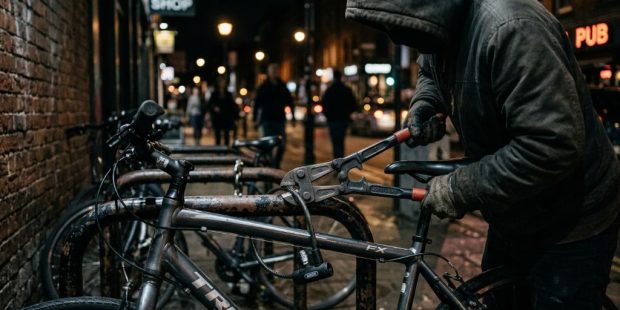
A bike disappears from a rack outside a coffee shop in about the time it takes to order a latte. In most cases, the theft wasn’t sophisticated — the owner simply locked the front wheel instead of the frame, or wrapped a thin cable around a signpost that lifted straight out of the ground. That’s why any serious answer to how to keep your bicycle secure in California starts with what riders get wrong: the lock they carry, the object they attach it to, and how long they leave the bike unattended. The mistakes below are the ones that show up again and again, and each one has a practical fix.
Quick Answer
Lock the frame — plus at least one wheel — to a fixed, immovable object using a hardened steel U-lock or chain, and keep the lock body tight so a jack or bolt cutter has no room to work. Remove quick-release parts, vary your parking spots, and record your serial number. In California’s denser cities, treat a cable lock as a secondary deterrent, never your only defense.
Key Takeaways
- Locking a wheel or a removable part instead of the frame is the single most common mistake — and the easiest to fix.
- Lock type matters, but locking technique and the object you attach to often matter more than the lock’s price tag.
- Anything that can be unbolted, lifted, or cut in seconds is not a secure anchor, no matter how solid it looks.
- Quick-release wheels, saddles, lights, and bags vanish fast; secure or remove them before you walk away.
- Recording your serial number and registering the bike won’t prevent theft, but it dramatically improves your odds of recovery.
Mistake 1: Locking the Wheel Instead of the Frame
A lock through the front wheel and nothing else means a thief can leave the wheel behind and walk off with everything else. Wheels are replaceable; frames are the expensive part.
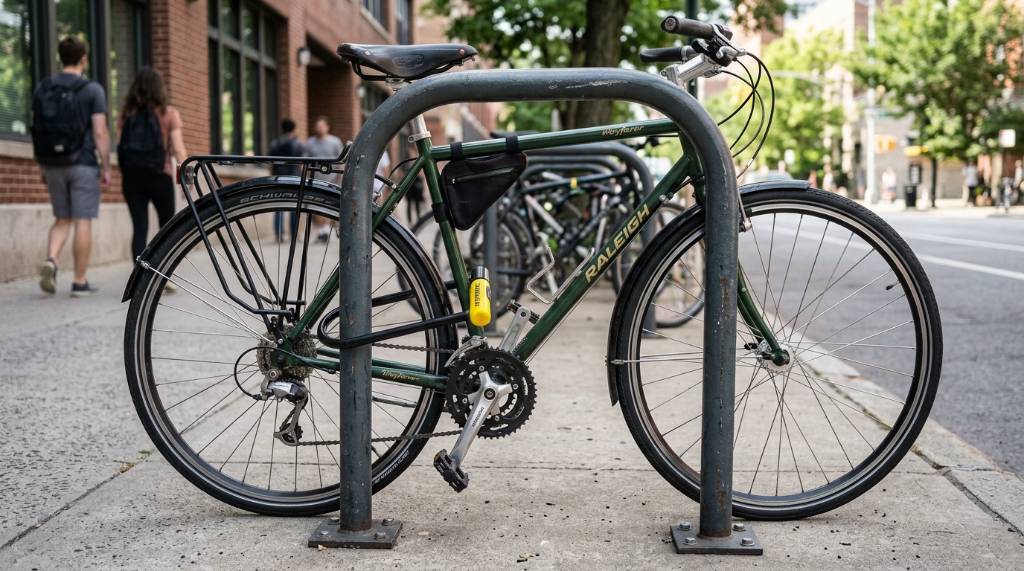
The reliable approach is to pass the lock through the rear wheel, the frame’s rear triangle, and the fixed object all at once. Because the rear wheel is usually the pricier of the two and sits inside the frame triangle, this single lock secures the most valuable components. If you carry a second lock or a cable, run it through the front wheel and thread it onto the main lock — not around the rack separately, To keep your drivetrain running smoothly after securing your ride, check out our guide on thebest bike chain lubes for dry and dusty conditions this year to maintain peak performance.
Why the frame triangle matters
Locking through the small triangle formed by the seat tube, chainstays, and seat stays leaves very little empty space inside the lock. That’s the point: a lock filled with metal and frame has no room for a pry bar or hydraulic jack. A lock dangling loosely around a thick post gives a thief exactly that room.
Mistake 2: Treating a Cable Lock as Your Only Lock
Cable locks are light, cheap, and convenient, which is precisely why they’re the most commonly defeated lock type. Most hand cable cutters make short work of a thin cable, and the job takes seconds. They’re fine as a secondary lock or for a two-minute stop in a low-risk spot. They are not fine as your only protection for a bike parked all day.
| Lock Type | Tool Resistance | Portability | Best Used For |
|---|---|---|---|
| Thin cable lock | Low | Very high | Secondary security, very short stops |
| Folding lock | Moderate to high | Moderate | Riders who want better protection without a heavy chain |
| Hardened steel U-lock | High | Moderate | Everyday urban parking, frame plus one wheel |
| Case-hardened chain lock | High | Low (heavy) | All-day parking in high-theft areas |
Notice that the table doesn’t include prices or brand rankings — those change constantly and vary by region. What doesn’t change is the relationship between steel thickness, lock mechanism quality, and how long a thief needs to defeat it. A cheap U-lock generally beats an expensive cable, but a poorly made U-lock with a weak cylinder can be picked or drilled quickly.
Mistake 3: Locking to Something That Isn’t Actually Fixed
This mistake catches experienced riders, not just beginners. A pole is only as secure as its base.
- Signposts with removable bases: Many street signs sit on a sleeve that lifts off with the sign still attached.
- Chain-link fences: One cut and the bike slides free.
- Parking meters and thin bollards: Often bolted down with hardware that can be loosened.
- Trees and wooden posts: Cuttable, and in many California cities, locking to a tree can violate local ordinances.
- Unbolted bike racks: Some racks are anchored with bolts a wrench can remove.
- Handrails and accessibility rails: Frequently prohibited and often structurally weak.
Before you lock up, give the anchor a shake and look at how it’s attached to the ground. If you can move it, so can someone else.
Mistake 4: Leaving Slack, or Locking Too Low
A lock resting on the pavement is easier to attack than one held at frame height. Ground contact gives a thief a stable surface to brace against and lets them swing a hammer or strike a chisel downward with full force. Keep the lock body off the ground and oriented so the keyway faces down or away from easy access.
Slack is the other half of this problem. A U-lock wrapped around a post so thick that the shackle barely closes leaves an open gap — a perfect target for a car jack or pry bar. Choose racks and posts that let the lock close as tightly as possible, even if that means walking an extra block.
Mistake 5: Ignoring What’s Still Attached to the Bike
Anything not secured by the lock is fair game, and thieves know it. Quick-release wheels, saddles with quick-release clamps, lights, GPS computers, panniers, and even pumps disappear routinely — sometimes before the thief bothers with the frame at all.
Practical fixes:
- Replace quick-release skewers with locking skewers or bolt-on versions.
- Swap a quick-release seat clamp for a bolted one, or run a short cable through the saddle rails.
- Take lights, computers, and bags with you. They take seconds to remove and are easy to resell.
- If you park in the same place daily, change spots occasionally. Predictable schedules help thieves plan.
A Locking Routine That Covers the Basics in Under a Minute
- Pick an anchor that doesn’t move and can’t be lifted or cut.
- Position the bike so the frame triangle and rear wheel sit inside the lock’s closed area.
- Close the lock as tightly as the anchor allows, keeping the body off the ground.
- Attach a secondary cable or lock through the front wheel and clip it to the main lock.
- Remove lights, bags, and anything else loose.
- Give the bike a gentle tug to confirm nothing shifts.
If any step feels rushed, that’s usually the one that gets skipped — and it’s usually the one that matters.
California-Specific Considerations
Bike theft pressure varies enormously across the state. Dense urban cores and university towns generally see higher volume than suburban or rural areas, and transit hubs — train stations, bus plazas, and park-and-ride lots — are recurring targets because bikes sit unattended for hours.
Two practical points for California riders:
- Registration programs help recovery, not prevention. Many police departments across the state participate in registration services or run their own, and having a recorded serial number makes it far easier for an officer to match a recovered bike to its owner. California doesn’t operate a single mandatory statewide bicycle registry, so check what your city offers.
- Theft charges depend on value. In California, property theft below a certain dollar threshold is generally handled as petty theft, while higher-value thefts can be charged as grand theft. That distinction affects how a case is processed, but it shouldn’t change how you lock your bike — assume every bike is a target.
Secure parking worth paying for
If your commute ends at a transit station, an enclosed bike station or rented locker is often the single biggest security upgrade available — bigger than any lock. The trade-off is cost, availability, and hours of operation. Where those options don’t exist, a well-lit, high-traffic rack with camera coverage beats a hidden spot, even though a secluded rack feels safer.
Frequently Asked Questions
Is a cable lock enough to secure a bike in California?
Not as your only lock in a city or on a college campus. Cable locks deter opportunistic theft, but most can be cut quickly with hand tools. Use one as a secondary lock for wheels and accessories, and carry a hardened U-lock or chain for the frame.
Should I lock my bike by the frame or the wheel?
Both, ideally in one motion. Pass the lock through the frame’s rear triangle and the rear wheel, then secure the front wheel with a cable or second lock. Locking only a wheel leaves the frame — the most valuable part — unprotected.
What should I do if my bike is stolen in California?
Report it to the local police department and provide your serial number, photos, and any distinguishing details. Then post the theft to regional cycling communities and check online resale listings. A police report is usually required for insurance claims and is often required before a recovered bike can be returned to you.
Where can I find my bike’s serial number?
Most bicycles have it stamped on the bottom bracket shell, underneath the crank area, or on the rear dropout. Some also place a sticker on the frame. Photograph it along with your bike and keep the image somewhere you can access from your phone.
Does locking my bike in a visible spot actually help?
Generally yes. Thieves prefer privacy and time. A rack in plain view of pedestrians, storefronts, or a security camera raises the chance someone notices or intervenes. The exception is a visible spot with no foot traffic at all — visibility only helps when people are actually around.
How long is it safe to leave a bike locked outside?
There’s no fixed safe duration. The realistic rule is that risk rises with time, value, and how predictable your parking pattern is. For anything longer than a work shift in a high-theft area, indoor or attended parking is worth the cost or inconvenience.
Conclusion
Bike theft is rarely about a thief outsmarting a rider — it’s about a rider leaving one obvious opening. Lock the frame and a wheel to something genuinely immovable, close the lock tightly, strip anything removable, and vary where you park. If you can add indoor or attended parking for long stays, do it. None of these steps are complicated, and together they remove nearly every easy opportunity a thief looks for.
