
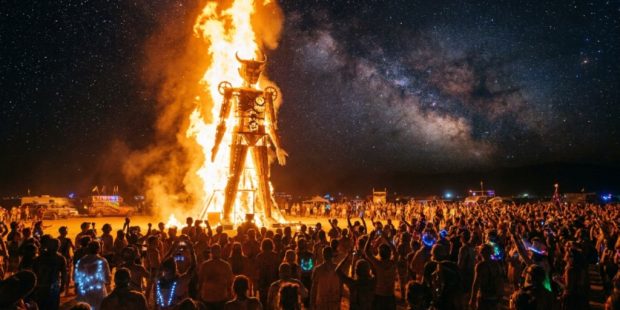
Once a year, a city appears in the middle of the Nevada desert. It has streets, neighborhoods, an airport, and a radio station. Then, after eight days, it vanishes without a trace. This is Black Rock City. This is Burning Man. And in 2026, it returns with one of its most ambitious themes yet.
Burning Man 2026 runs from August 30 through September 7 in the Black Rock Desert, Pershing County, Nevada. The theme this year is Axis Mundi. Over 70,000 participants from more than 100 countries will gather to build art, form community, and experience something that resists easy explanation. If you are planning to attend or simply want to know what all the fuss is about, this guide covers everything you need.
Understanding the 2026 Theme: What Is Axis Mundi?
Axis Mundi is a concept found across dozens of cultures and spiritual traditions. It refers to the cosmic axis — a central point that connects the heavens, the earth, and the underworld. Think of the World Tree in Norse mythology, the sacred mountain in Hindu cosmology, or the pole that many indigenous peoples regard as the spine of the universe.
At Burning Man, this idea takes on a very specific form. The Man, the large wooden effigy at the center of Black Rock City’s circular street grid, has always served as the physical and symbolic center of the gathering. Therefore, in 2026, that meaning is made explicit. The Man is the axis. Everything and everyone rotates around it.
The theme also speaks to connection. In a world that can feel fragmented and isolating, Axis Mundi invites participants to find the center point. It asks what holds us together. Additionally, it encourages art, camps, and costumes that explore trees, mountains, sacred geometry, celestial patterns, and the meeting points between worlds.
The Central Art Structures of 2026
Temple of the Moon
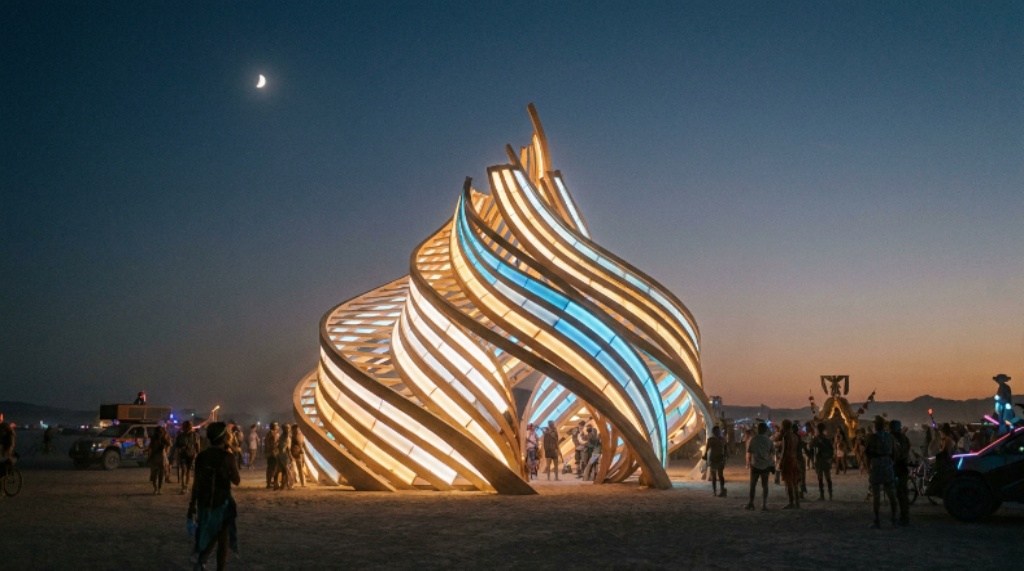
Every year, Burning Man erects a Temple that serves as a non-denominational space for reflection, grief, and remembrance. In 2026, that structure is the Temple of the Moon, designed by artist James Gwertzman and the Moonlight Collective.
The design draws inspiration from two sources. The first is the Queen of the Night, a rare desert cactus flower that blooms for only a single evening each year. The second is the lunar cycle itself. Together, these influences shape a structure that speaks to impermanence, beauty, and release.
People leave notes, photographs, and mementos inside the Temple throughout the week. On the final night of the event, Sunday September 6, the Temple is burned in a ceremony that tends to be quieter and more emotional than the burning of the Man. It is one of the most powerful experiences on the playa for many longtime attendees.
Cryptomeria: The Man Pavilion
The structure surrounding the Man is called Cryptomeria in 2026, designed by Alexander Rose. The design references the ancient Jōmon Sugi cedar tree of Japan, one of the oldest living trees on Earth. A 60-foot double-helix staircase winds through the pavilion, creating a visual echo of both tree trunks and human DNA.
Together, the Temple of the Moon and Cryptomeria anchor the visual and cultural landscape of this year’s event. They are must-see destinations for any participant.
Art Installations Across the Playa
Burning Man Project has announced 75 Honoraria Art Grant recipients for 2026, representing artists from 15 countries and 17 U.S. states. The combined grant funding reaches $1.3 million, part of a broader annual arts investment of nearly $6 million.
The selections reflect the Axis Mundi theme beautifully. Among the submissions were 41 tree-themed proposals, with six ultimately selected. Concepts also explore mountains, the human body, and cosmic connection. Additionally, 14 of the projects will incorporate fire elements, one of the signature features of the playa experience.
Descriptions of selected works include a flame-breathing garden gnome, an octopus installation, and a climbable treehouse. In total, nearly 400 temporary art installations will be spread across Black Rock City during the event.
However, it is important to understand something about the programming. There are no headliners. There are no stage times and there is no official schedule of acts to follow. The art installations, the theme camps, and the mutant vehicles are the program. You find your experience by exploring.
How to Get Your Tickets
Tickets for the event are available through several sales channels, all organized by Burning Man Project. Understanding the system in advance saves a lot of frustration.
The ticket pricing structure for 2026 is as follows:
- $675 “Get the Gift” tickets (limited quantity, lower-income accessibility tier)
- $775 “Pay Your Way” tickets (the standard option)
- $975, $1,500, and $3,000 “Give the Gift” tickets (which help subsidize others)
Several programs exist to improve access. The Ticket Aid program offers $250 reduced-price tickets to participants on limited incomes. The Renaissance program invites collectives and inspired groups to bring their networks to Black Rock City. The Resilience program provides tickets to people recently affected by natural disasters or geopolitical conflict.
All three programs opened in late February 2026. The Stewards Sale for core event contributors took place in March. The Main Sale opened on April 29, 2026, at noon Pacific Time, with advance registration required.
If tickets sell out in the Main Sale, the STEP (Secure Ticket Exchange Program) is the only approved resale platform. Do not buy tickets from third-party resellers. Fraud is common, and only tickets transferred through STEP are verified as legitimate. All official ticket information is at tickets.burningman.org.
Key Dates to Mark on Your Calendar
The structure of the week matters. Here is how it unfolds:
- August 30: Gates open, participants begin arriving
- August 30 through September 4: The week of art, camps, community, and exploration
- September 5 (Saturday): The Man burns
- September 6 (Sunday): The Temple burns
- September 7 (Monday, Labor Day): Exodus begins
Plan your arrival and departure with these dates in mind. Many participants arrive early to help build camps and leave after the Temple burn. However, Exodus traffic on September 7 can be significant, so leave extra time in your schedule.
Dressing for the Axis Mundi Theme
The event is famously a place of radical self-expression through clothing. The 2026 theme opens up rich visual territory for costumes and outfits.
Think of the imagery connected to the idea of a cosmic center point. Trees with deep roots and branches reaching into the sky fit perfectly. Starfield patterns, constellation motifs, and lunar imagery all work well. Sacred geometry, ancient mythology, Norse and Celtic symbolism, and celestial color palettes like deep green, midnight blue, bark brown, and gold are all natural fits.
Practically speaking, your outfit needs to handle extreme conditions. Daytime temperatures on the playa can exceed 100 degrees Fahrenheit. Nights drop sharply, sometimes below 50 degrees. Dust storms can arrive with little warning. Therefore, layering is essential. Breathable fabrics for the day, insulating layers for the evening, and goggles plus a dust mask for storms are all non-negotiable.
Also, avoid anything that sheds. Loose glitter, detachable sequins, and feather boas create MOOP, which stands for Matter Out of Place. Leave No Trace is one of the ten core principles. Your outfit choices should support that principle, not undermine it.
Survival Hacks That Actually Work
Black Rock City demands genuine self-reliance. The desert environment is not forgiving of poor preparation. These hacks are drawn from experienced attendees and the official Survival Guide at burningman.org.
Water Is Your First Priority
Bring more water than you think you need. The dry desert air means you sweat without feeling it. Dehydration happens fast and quietly. The official recommendation is at least one and a half gallons per person per day. Add electrolyte powders to your water. Plain water alone is not enough when your body is losing salt through constant perspiration.
Protect Yourself from Playa Dust
The dust at Black Rock City is not ordinary dirt. It is fine, alkaline, and relentless. It gets into everything: your nose, your lungs, your camera, your phone, your food. Pack a bottle of vinegar to neutralize the pH on your skin and prevent a condition known as Playa foot, which causes cracking and irritation. Double-bag all electronics and clothing in zip-lock bags or sealed bins. Sealed goggles are essential for dust storm whiteouts. Do not rely on ordinary sunglasses.
Your Bike Is Not Optional
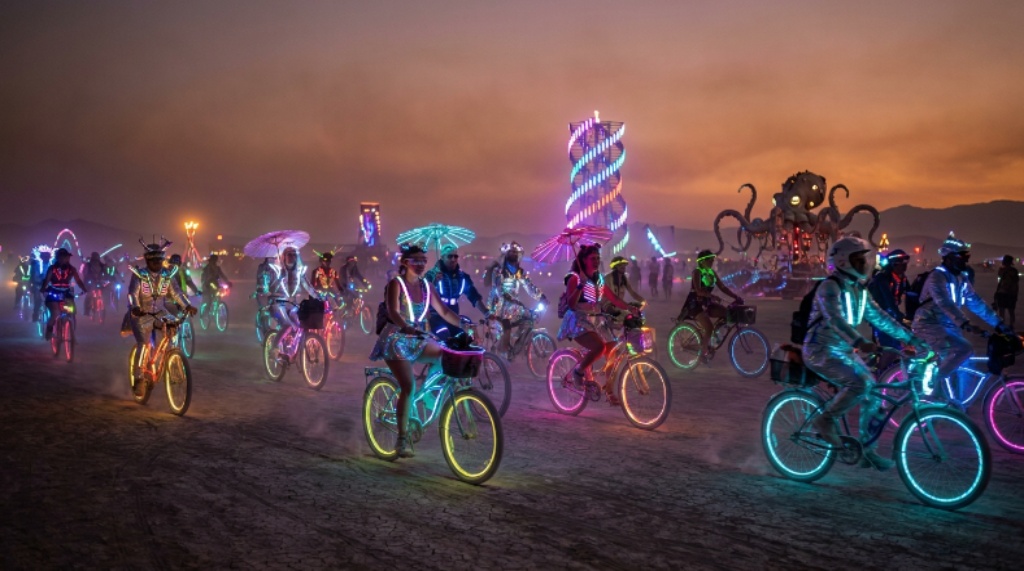
Black Rock City is a real, functioning city. The deep playa where major art installations live is not walking distance from most camps. You need a bike. Decorate it with distinctive lights so it stands out in the dark. A plain, unlit bike is nearly impossible to identify in a crowd of thousands, and losing your bike in the desert is a misery worth avoiding.
Prepare Your Camp for Real Conditions
Shade structures must be staked down firmly. The wind on the playa is strong enough to destroy an unprepared camp in minutes. Use 12-inch rebar stakes and secure everything with guy lines. Bring a mallet. Top any exposed rebar with a tennis ball or plastic cap to prevent injury in low visibility.
Food Should Be Simple
Plan shelf-stable meals that require minimal cooking and minimal cleanup. Gray water management on the playa is a headache. The less mess you generate, the better your week will be. Dried foods, vacuum-packed meals, nuts, and calorie-dense snacks are ideal. Additionally, gifting food to campmates and neighbors is one of the most meaningful ways to build community on the playa.
Fill Up Before You Arrive
Gas stations become scarce quickly once you leave the highway. Fill your tank at Fernley, Nevada, which is the last reliable stop before the Black Rock Desert. Bring directions in printed form. Cell signal disappears for long stretches of the route, and GPS on your phone will not work reliably once you are past Fernley.
The Ten Principles: Understanding the Culture
The event operates around ten principles that shape every aspect of life in Black Rock City. These are not just guidelines. They define what the community is.
The principles include Radical Self-Reliance, Gifting, Decommodification, Radical Inclusion, Civic Responsibility, Communal Effort, Participation, and Leave No Trace. There are no sponsors, no advertisements, and no transactions inside the event (except for ice and coffee at center camp). Everything else operates on a gift economy.
This is one of the reasons first-timers are sometimes surprised. There is nothing to buy. There is no vendor selling water when you run out and there is no staff handing out supplies. You are expected to bring everything you need and to share freely with those around you. This is not a burden. It is, for most people, one of the most liberating aspects of the experience.
Conclusion
Burning Man 2026 is shaping up to be a remarkable gathering. Running from August 30 through September 7 in Nevada’s Black Rock Desert, the event brings together over 70,000 participants under the theme Axis Mundi — the idea of a central point connecting all things. The Temple of the Moon and the Cryptomeria Man Pavilion anchor the visual landscape, while 75 funded art installations and nearly 400 total artworks fill the playa with wonder.
Tickets range from $675 to $3,000 and are available through the official Burning Man Project system, with accessibility programs in place for those who need support. Survival on the playa requires real preparation: water, dust protection, a reliable bike, proper shade, and a stocked camp are all essential. However, those who prepare well find themselves in one of the most extraordinary human experiences on the planet. The cosmos has an axis. In late August, it runs through the Nevada desert.
Frequently Asked Questions
When and where does the event take place in 2026?
Burning Man 2026 takes place August 30 through September 7, 2026, at Black Rock City in the Black Rock Desert, Pershing County, Nevada. The Man burns on September 5 and the Temple burns on September 6.
What is the Axis Mundi theme about?
Axis Mundi refers to the cosmic axis — a central connecting point found in spiritual traditions worldwide. The theme explores trees, sacred geometry, celestial imagery, interconnectedness, and the idea that the Man at the center of Black Rock City serves as the axis around which all of community life revolves.
How much do tickets cost and where can I buy them?
Tickets range from $675 to $3,000 depending on the tier chosen. Standard tickets start at $775. All purchases should be made through the official Burning Man Project ticketing system at tickets.burningman.org. For resale, only use the STEP platform.
What should a first-time attendee know before going?
First-timers should read the official Survival Guide at burningman.org in full before arriving. Key items include bringing at least 1.5 gallons of water per person per day, packing dust goggles and a mask, bringing a decorated bike, and securing shade structures firmly against desert winds. Preparation is not optional.
Is Burning Man a music festival?
Burning Man is not a traditional music festival. There are no scheduled headliners, no main stages, and no lineup to follow. Music exists across hundreds of theme camps, but the experience is primarily driven by art installations, community participation, mutant vehicles, and the principles of self-expression and self-reliance.
